DANIEL 7 - FOUR BEASTS
Updated: Aug 1
AND A LITTLE HORN

Daniel chapter 7 parallels Daniel chapter 2 being the complete symbolic prophecy adding greater detail to the prophecy of Daniel 2. Daniel 8 and 11 parallel each other, both commencing with the Kingdom of Medo-Persia, Babylon having passed off the scene of prophecy.
ABB'A'
The ABB'A' arrangement reflects the chiastic structure of the Book of Daniel.
What is a CHIASTIC structure?
It is a literary device or pattern in which two ideas (A & B) or more are presented and then re-presented in a reverse order (B' A') so as to convey a more complete meaning.
The simplest chiasmus is found in Mark 2:27:
"And he said unto them, The sabbath (A) was made for man (B), and not man (B') for the sabbath: (A')" conveying the idea that the Sabbath was made after man was created and not vice versa, hence man has no authority over the Sabbath except for the one who made the Sabbath. The Son of man, therefore, is Lord of the Sabbath Day as he made it for man. It is His prerogative and not man's to decide how the Sabbath is to be kept holy which was the contention in Mark chapter 2.
THE CHIASTIC STRUCTURE OF DANIEL - A B B' A'
Daniel chapter 2 presents the image of a MAN (A)
Daniel chapter 7 presents the vision of BEASTS (B)
Daniel chapter 8 presents the vision of BEASTS (B')
Daniel chapter 11 presents the MEN who ruled the Kingdoms (A')
In interpreting the symbols used in prophecy one must allow the Scripture itself to explain the symbol in order to arrive at the correct interpretation of the said symbol.
SYMBOLS USED IN PROPHECY FOR KINGDOMS, NATIONS OR POWERS
1. “King” used interchangeably with "Kingdom" - Dan 2:37-38, Dan 7:17,23
2. “Mountain” symbolic of a kingdom - Dan 2:35, Rev 17:9
3. “Beasts” used interchangeably with “Kings”, hence represent kingdoms - Dan 7:17,23
4. “Beasts” are also said to be Kingdoms - Dan 7:23
5. “Horns” represent Kings / Kingdoms - Dan 8:20-22
6. “Heads” are symbolic of kingdoms - Dan 7:6, Dan 2:38
7. “Waters” are symbolic of kingdoms, nations, tongues - Rev 17:15
8. “Great City” used interchangeably with kingdom - Rev 14:8, 16:19
9. “Ribs” symbolic of kingdoms - Ram conquers in 3 directions, so no beast can stand before it. Bear has 3 ribs in its mouth - Dan 7:7, Dan 8:4
PROPHECY REPEATED & ENLARGED UPON
Prophecy of Daniel 2 is repeated & enlarged upon in Daniel 7, 8 & 11.
In Daniel 7 the 4TH beast is said to be the 4TH kingdom - Daniel 7:23.
The mention of kingdoms in Daniel 7 refers back to the kingdoms in Daniel 2
Hence the 3rd beast is the 3rd kingdom of Daniel 2
The second beast is the second kingdoms of Daniel 2
The first beast must be the first kingdom of Daniel 2 - BABYLON
The fourth kingdom in Daniel 2 was ROME
Hence the fourth beast of Daniel 7 is symbolic of ROME.
The Iron & Clay feet is symbolic of ROME mixed with religion
Hence the Iron & Clay of the feet represent Papal Rome
DANIEL 2 & 7
Chapter 7 is the most complete symbolic vision - four beasts and a Little Horn.
It parallels the Daniel 2 image's four metals & clay.
Four worldly kingdoms are described in the Daniel 2 dream.
Four beasts symbolic of four kingdoms are described in Daniel 7:23.
The fourth kingdom of Daniel 2 is made of Iron
The fourth beast of Daniel 7 has iron teeth.
The fourth kingdom of Daniel 2 "breaketh in pieces" - Dan 2:40
The fourth beast of Daniel 7 "brake in pieces" - Dan 7:7
The fourth Kingdom is divided in Daniel 2
The Fourth Kingdom is divided in Daniel 7
Daniel 2 has the image of a Man.
Daniel 7 has the eyes & mouth of a Man
The Daniel 2 image is destroyed after the division
The Daniel 7 beast is destroyed after the division
In Daniel 2 the kingdom of God is set up at the end.
In Daniel 7 the Kingdom of God is set up at the end.
The fourth beast is said to be the fourth kingdom - Dan 7:23
Hence, the 4th beast of Daniel 7 is the kingdom of Iron of Daniel 2.
Therefore, the 1st beast, the Lion, is the first kingdom of gold - BABYLON - Dan 2:38
The iron (Rome) & clay (Religion) is the union of church & state in the form of the ROMAN Catholic Church and its long succession of Popes. Point is, if the fourth beast is the fourth kingdom, then somewhere in the fourth beast must lie the clue to the religio-political system of Papal ROME, the union of church and state (IRON & CLAY) as found in the image of Daniel chapter 2. We suggest and will show this to be the Little Horn of Daniel 7
Daniel 7 then identifies the "IRON & CLAY" of Daniel 2 in the fourth beast with added details as to the sort of power it is with some very startling revelations. Be prepared to hear some things which may be quite shocking as the Scripture outlines in prophetic detail the identity of the little horn of Daniel chapter 7 - Papal Rome.
Daniel 2 deals largely with political changes. The four beasts in Daniel 7 parallel the four metals in the image of Daniel 2 and represent the same four kingdoms:
BABYLON
MEDO-PERSIA
GRECIA
ROME AND ITS TRANSITION TO PAPAL ROME
In Daniel 7 the focus of attention moves toward the last period of earth’s history. The judgment is described as occurring some time before the fourth beast is destroyed.
Daniel 7, like the rest of the book, was given to show the people of God their part in the great controversy between Christ and Satan and the efforts of Satan to destroy them through to their final victory.
SUMMARY OF DANIEL 7
Verses 1 - 8: Four earthly Kingdoms in the form of four Beasts
Verses 9 - 14: The Judgment scene
Verses 15 - 21: Further details of the 4th beast & Little horn
Verse 22: - Return to the Judgment scene
Verses 23-25: - Return to the 4th Earthly Kingdom
Verses 26-28: - The judgment & dominion given to the saints
DANIEL CHAPTER 7
Daniel's prophetic ministry commences here in Daniel chapter 7 and continues in chapters 8,9 and 11
DANIEL'S DREAM AND VISIONS OF HIS HEAD
1 In the first year of Belshazzar king of Babylon Daniel had a dream and visions of his head upon his bed: then he wrote the dream, and told the sum of the matters.
2 Daniel spake and said, I saw in my vision by night, and, behold, the four winds of the heaven strove upon the great sea.
verse 1
The first year of Belshazzar’s joint ruler-ship with his father Nabonidus was about 552B.C.
Daniel had a dream [literally “saw a dream”]
Sum of the matters [The Aramaic is difficult to translate. The word “sum” is re’sh, which means “head,” or “beginning.” The original Greek version reads, “eis, kephalaia logon,” which may be interpreted “summary.” Evidently Daniel wrote down the chief contents of the dream. Ehrlich translates the phrase, “the important details.”].
Winds represent strife or war - Jeremiah 25:32, 49:36, 3751:1
Seas represent nations, kingdoms - Rev 17:15, Isaiah 57:20
Beasts represent Kingdoms - Dan 7:17, 23
Some believe the great sea represents the Mediterranean Sea where these beasts did battle, however, seas or waters are symbolic of peoples or nations. Here, nations doing battle with each other resulting in the rise and fall of these world empires.
Here in verse 1 as predicted we see a battle of nations resulting in the rise and fall of the important nations in Bible prophecy
verse 2
The four winds of the heaven [Aramaic ruach, equivalent to the Hebrew ruach, which has a variety of meanings:
“Air” (Jer 2:24), translated “wind”,
“breath” (Job 19:17)
human “spirit” (Ps 32:2)
divine “Spirit” (Ps 51:12),
“wind” (Exo 10:13).
Metaphorically the word is also used for vain & empty things (Jer 5:13).
In the vision here it apparently denotes strife & war (See Jer 49:36-37; 25:31-33) for that which arises as an result of the winds stirring up the symbolic sea of peoples are nations]
Strove [Aramaic, guach, which means to “stir up.” The form of the verb suggests continued action] upon the great sea [No specific body of water such as the Mediterranean is inferred. Like the beasts which arise from it, the sea here is symbolic. Waters symbolize many peoples. Rev 17:15; Isa 57:20; 60:5].
verse 3
And four great beasts [according to verse 17 these beast symbolize “four kings which shall arise out of the earth.” For “kings” the LXX, Theodotiioans and the Vulgate read “kingdoms.” The fourth beast is specifically called the “fourth kingdom.” (v 23). These is general agreement that these four kingdoms parallel the four world powers symbolized by the metallic man of Daniel 2 which came up successively, first, second, third etc. from the sea. The beasts were diverse (different). The diversity here spoken of was represented by the different metals in the vision of Daniel 2.
*The connection between Daniel 2 and 7 is seen in that the kingdoms of Daniel 2 are numbered and so are the beasts of Daniel 7. In addition the fourth beast is said to be the fourth KINGDOM and first mention should take us back to Daniel 2 where KINGDOMS were first introduced.
THE LION - THE FIRST BEAST, THE FIRST KINGDOM OF DANIEL 2

4 The first was like a lion, and had eagle's wings: I beheld till the wings thereof were plucked, and it was lifted up from the earth, and made stand upon the feet as a man, and a man's heart was given to it.
"The fourth beast is the fourth kingdom" - Daniel 7:23
The third beast must be the 3rd kingdom of Daniel 2.
The second beast, the second kingdom.
The first beast, the lion, the first kingdom.
This first Kingdom of Daniel 2 is BABYLON - Daniel 2:38
Hence, the Lion of Daniel 7 represents BABYLON.
“The lion, the animal of Ishtar, was so favourite a subject at all times in Babylonian art, that its rich and lavish employment at the gate of Babylon, the Ishtar gate, is by no means abnormal.” The Excavations at Babylon, R. Koldeway, p 46. and had eagle's wings [The lion was known for its strength, the eagle for its power and range of flight (See 2Sam 1:23). Nebuchadnezzar’s power was felt from the Mediterranean to the Perisan Gulf, and from Asia Minor to Egypt. This was fittingly represented by the lion equipped with eagles wings]: I beheld till the wings thereof were plucked [In its latter years Babylon lost the power and glory it possessed in earlier years. The plucking of his wings may refer to the humiliation of the proud Nebuchadnezzar, the king of Babylon during his period of madness (Daniel 4:31-37), or to the cowardice of Belshazzar, the last king of Babylon, who, instead of driving away his foes like a lion, shut himself up in the city, feasting and drinking with his lords, till he was killed, and the kingdom given to the Medes and Persians cf. Daniel 5:22-30], and it was lifted up from the earth, and made stand upon the feet as a man, and a man's heart was given to it [A loss of lion like characteristics. “The [human] heart is... desperately wicked (Jer 17:9). Belshazzar’s wickedness was seen in his drinking from God’s sacred vessels (Dan 5:1-3)].
EAGLE'S WINGS represent speed of conquest (Eze 17:3, 12; Lam 4:19; Hab 1:6-8). The lion was known for its strength, the eagle for its power and range of flight (See 2Sam 1:23). Nebuchadnezzar’s power was felt from the Mediterranean to the Perisan Gulf, and from Asia Minor to Egypt. This was fittingly represented by the lion equipped with eagles wings]:
WINGS THEREOF WERE PLUCKED. - no longer swift to conquer and cannot cover a large territory. In its latter years Babylon lost the power and glory it possessed in earlier years. The plucking of his wings may refer to the humiliation of the proud Nebuchadnezzar, the king of Babylon during his period of madness (Daniel 4:31-37), or to the cowardice of Belshazzar, the last king of Babylon, who, instead of driving away his foes like a lion, shut himself up in the city, feasting and drinking with his lords, till he was killed, and the kingdom given to the Medes and Persians cf. Daniel 5:22-30
And it was lifted up from the earth, and made stand upon the feet as a man, and a man's heart was given to it A loss of lion like characteristics. “The [human] heart is... desperately wicked (Jer 17:9). Belshazzar’s wickedness was seen in his drinking from God’s sacred vessels (Dan 5:1-3)].
Manʼs heart given it is symbolic of the loss of lion-like qualities (strength, power) and desperate wickedness. (Jer 17:9). Daniel 2 comes to our aid in identifying the kingdom the lion is symbolic of as noted above. The fourth beast is the fourth kingdom, hence the first beast must be the first kingdom of Daniel 2 - The Lion is Babylon.
THE BEAR - THE 2ND BEAST, THE 2ND KINGDOM OF DANIEL 2

5 And behold another beast, a second, like to a bear, and it raised up itself on one side, and it had three ribs in the mouth of it between the teeth of it: and they said thus unto it, Arise, devour much flesh.
Note the characteristics of the Bear:
The bear is raised up on one side
It has three ribs in its mouth
It was strong - it devoured much flesh
And behold another beast, a second, like to a bear The Medes and Persians correspond to the silver in the image. See Daniel 2:39 and Daniel 5. As a bear is in some respects inferior to the lion so the Medes & Persians were inferior to Babylon. They were nevertheless cruel and rapacious in character (See Isa 13:17, 18)],
AND IT RAISED ITSELF ON ONE SIDE. No interpretation of this aspect is given in this chapter. However, a comparison with Daniel ch. 8:3, 20 reveals that the empire was made up of two parts. Of the Medes and the Persians, the latter became the dominant power a few years before the dual Empire conquered Babylon. The margin’s alternative translation reads: “ it raised up one dominion.”],
And it had three ribs in the mouth of it between the teeth of it. These are not interpreted in this chapter. A comparison with chapter 8 shows that Medo-Perisia conquered in three directions.
The three ribs represent those kingdoms the Medo-Persian Empire conquered as it expanded:
North- Babylon
West- Lydia
South- Egypt. (cf. the Ram of Dan 8:3-4, 20)
And they said [the speaker is not identified] thus unto it, Arise, devour much flesh
Medo Persia conquered Babylon in the following way:
“[Babylon had] stored provisions enough for very many years; so they cared nothing for the siege; and Cyrus knew not what to do... whether, then someone advised him in his difficulty, or he perceived himself what to do, I know not, but this is what he did... drawing off the river by canal... he made the stream to sink till its former channel could be forded. When this happened the Persians who were posted with this intent made their way into Babylon by the channel of the Euphrates... and brought them to a miserable end.” Herodotus, Book 1, sec 191; A.D. Godley, Loeb Classical Library, p239].
Daniel 8 comes to our aid in identifying the kingdom represented by the bear.
THE RAM OF DANIEL CHAPTER 8
3 Then I lifted up mine eyes, and saw, and, behold, there stood before the river a ram which had two horns: and the two horns were high; but one was higher than the other, and the higher came up last.
4 I saw the ram pushing westward, and northward, and southward; so that no beasts might stand before him, neither was there any that could deliver out of his hand; but he did according to his will, and became great.
Note the characteristics of the Ram:
It has two horns - one higher than the other
It conquered beasts westward, northward & southward
No beast (kingdoms toward the West, South and North) could stand against it
It was so strong it became great
The three ribs in the Bear's mouth represents the three beast kingdoms the Medo-Persian Ram, conquered.
The Bear of Daniel 7 and the Ram of Daniel 8 both represent the Medo-Persian Kingdom.
In addition BABYLON falls to the MEDES & PERSIANS in Daniel chapter 5:28-31
Three ribs in the mouth - ribs come from the chest of an animal / beast. In this case defeated beasts. Beasts represent kingdoms. Ribs in the mouth, therefore, represent Medo-Persiaʼs three main conquests:
Lydia 547BC
Babylon 539BC
Egypt 525BC.
Hence, the Bear of Daniel 7 represents the Medes & Persians of chapters 5 and 8
THE LEOPARD - THE 3RD BEAST, THE 3RD KINGDOM OF DANIEL 2

Note the characteristics of the Leopard:
It has four wings - swift in conquest
It has four heads
Dominion was given it
The Lion had two wings. The Leopard has four wings. It is much faster than the Lion in its conquests.
VERSE 6
After this I beheld, and lo another, like a leopard
GRECIA was the power which succeeded Medo-Perisia (Daniel 8:21) Grecia must not be confused with classical Greece inasmuch as that period preceded the fall of Persia. The Grecia of Daniel was the semi-Greek Macedonian Empire founded by Alexander the Great which inaugurated what is called the Hellenistic period. Not until Alexander’s day could reference be made to the first “king” (ch. 8:21) of a Greek Empire who was a “mighty king” with “great dominion” (ch. 11:3)
which had upon the back of it four wings of a fowl
Wings indicate great speed and range. The leopard itself can move with great speed but its natural swiftness was inadequate to describe the amazing speed of Alexander’s conquest. There is no other example in ancient times of such rapid conquest over such vast distances. Grecia, with leopard like swiftness, conquered all before it. Both the leopard and the wings show that this kingdom would move with great speed (cf. Hab 1:8).
“In this short space of 8 years Alexander had annexed an area of little less than 2 million square miles...[consider] The amazing rapidity of his conquests.” The Growth of European Civilization, A.E.R. Boak, p 59-60
THE LEOPARD OF DANIEL 7
Had four heads (Dan 7:6)
Had four wings (Dan 7:6)
Leopard followed the bear - bear raised on one side (Dan 7:5).
The leopard followed a bear with 3 ribs in its mouth (Dan 7:5)
THE HE-GOAT OF DANIEL 8:20-22
Had four horns (Dan 8:8)
Moving so fast it “touched not the ground” (Dan 8:5)
The goat followed a ram which had one horn raised (Dan 8:3).
Goat followed a Ram which “pushed” in 3 directions (Dan 8:4),
Clearly the Leopard and the He-Goat represent the same power. The Goat is said to represent Grecia, hence the Leopard of Daniel 7 represents Grecia. See also Dan 11:3-4; the beast had also four heads [After Alexander the Great died his kingdoms was divided into four Helenistic kingdoms by four of his generals.
The victors divided the spoils;
Lysimachus
Seleucus
Ptolemy
Cassander
Hellenistic Civilization, W.W. Tarn, p 9.
“Alexander the Great, king of Macedonia, overthrew the Persian Empire, carried Macedonian arms to India, and laid the foundation for the Hellenistic world of territorial kingdoms.” Encyclopaedia Britannica, Vol 1. 1989, p240.
“...the ultimate division of the Empire into separate and independent kingdoms was foreshadowed by the division of the provinces among the chief generals of Alexander...the result of which was the formation of FOUR CONSIDERABLE KINGDOMS: Macedonia, Syria, Egypt, and Thrace.” Greece, E.S. Shuckburgh, p235.
Alexander died without arranging who was to succeed him. His half brother Philip and then his posthumous son Alexander were titular rulers under the regency of one or another of the generals and the empire was divided into a large number of provinces, the most important being controlled by about six leading generals called satraps (governor). Neither puppet king had the authority to weld the vast empire together. During twelve years of struggle both ‘kings’ were slain and territories changed repeatedly.
Antigonus emerged as the first claimant for central power but was oppossed by a coalition of four leaders: Cassander, Lysimachus, Ptolemy and Seleucus. In 306 Antigonus declared himself king (jointly with his son Demetrius) and successor of Alexander. Thereupon the other four, abandoning their subordinate titles of satraps, declared themselves kings of their respective territories.
At the battle of Ipsus (301 B.C.) Antigonus was killed, Demetrius fled and their territory was divided. This left four independent kingdoms, with the exception of small fragments, in place of Alexander’s empire. Demetrius had no kingdom just control over some coastal cities and a navy. He later displaced the heirs of Cassander and founded the Antigonid Dynasty in Macedonia. About 20 years after the division four reduced to three when Lysimachus was eliminated and much of his territory was taken by the Seleucid Empire or fell apart into small independent states, the most important being Pergamum. Macedonia, Egypt and the Seleucid Empire (sometimes called Syria because the eastern part was soon lost) continued on until they were all absorbed into the Roman Empire.
Many historians in giving a general overview omit the details but the fact remains that the Empire of Alexander did divide into four divisions as the prophecy foretold. Some seek to find the continuation of the four into Roman times by reckoning Pergamum as the successor of Lysimachus but whether we speak of three principal kingdoms and a group of smaller states it is significant that Alexander’s Empire did divide, for a time, into four kingdoms.
Note: Even in its divided state Alexander’s Empire, except for political centralization, constituted as much a unity as it ever had done under Alexander and the various divisions were aptly represented as part of the same beast with multiple heads;
AND DOMINION WAS GIVEN TO IT.
The language of Greek became the common language of the ancient world in preparation for the promulgation of the gospel - the New Testament was written in Greek. The next Empire (Rome) provided the roads and a period of relative peace for the initial spread of the gospel.
THE HE-GOAT OF DANIEL CHAPTER 8

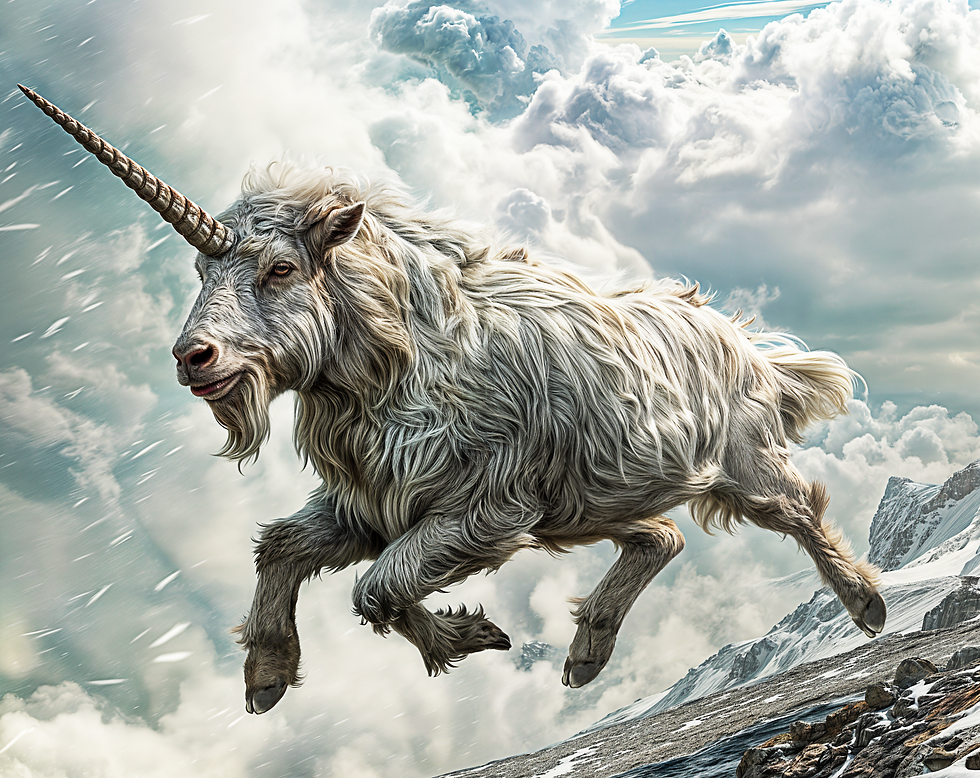
5 And as I was considering, behold, an he goat came from the west on the face of the whole earth, and touched not the ground: and the goat had a notable horn between his eyes.
6 And he came to the ram that had two horns, which I had seen standing before the river, and ran unto him in the fury of his power.
8 Therefore the he goat waxed very great: and when he was strong, the great horn was broken; and for it came up four notable ones toward the four winds of heaven.
21 And the rough goat is the king of Grecia: and the great horn that is between his eyes is the first king (Alexander the Great).
Note the characteristics of the He-Goat:
It touched not the ground - swift like the leopard
It had four horns and horns represent kingdoms. Note the leopard had four heads
Heads represent kingdoms
The He-Goat became very great

TERRIBLE BEAST, THE 4TH BEAST, 4TH KINGDOM OF DANIEL 2

7 After this I saw in the night visions, and behold a fourth beast, dreadful and terrible, and strong exceedingly; and it had great iron teeth: it devoured and brake in pieces, and stamped the residue with the feet of it: and it was diverse from all the beasts that were before it; and it had ten horns.
The fourth beast is said to be the fourth kingdom of Daniel 2, then the third, second and first beasts are symbols of the third, second and first kingdoms of the Daniel 2 image. The fourth kingdom in Daniel 2 was ROME, hence the fourth beast of Daniel 7 is symbolic of ROME.
VERSE 7
After this I saw in the night visions [dream], and behold a fourth beast
ROME - The Roman Empire succeeded Greece. The transition from the Hellenistic kingdoms to Rome was gradual and no one event marks the change. Several events have been suggested as the significant turning point:
By 200 BC Rome was the mistress of the western Mediterranean.
In 197 BC she defeated Macedonia and set up the Greek states under her own protection. In 190 BC Rome defeated Antiochus III and took the Seleucid territory as far as the Tarsus mountains.
In 168 BC she ended the monarchy in Macedonia and divided it into four confederacies and the same year warned Antiochus IV (Epiphanes) away from his attack on Egypt.
In 146 BC Rome annexed Macedonia as a province and placed most of the Greek states under the governance of Macedonia.
If Rome’s control of the East is reckoned from the removal of the three Hellenistic kingdoms by Roman power then 168 BC may be regarded as the first step in this process. However the Seleucid and Ptolemaic kings remained on their thrones till 63 in Syria and 30 in Egypt. If the dates for the annexation of these three kingdoms as Roman provinces are chosen, the dates would be 146, 64, 30 respectively. Some emphasize 168B.C. because by this time Rome had conquered Macedonia and had saved Egypt from falling to the Seleucid kingdom by merely forbidding the invasion of Antiochus IV (Epiphanes). This demonstrated that Rome virtually controlled all three kingdoms even though she had as yet conquered only one of them.
The process was a gradual one and whatever date one chooses as most significant it is clear that Rome absorbed the territory of Alexander from Macedonia to the Euphrates by 30B.C.,
DREADFUL AND TERRIBLE, AND STRONG EXCEEDINGLY; AND IT HAD GREAT IRON TEETH.
The fourth beast parallels the legs of the iron kingdom of Daniel 2:40:
"it devoured and brake in pieces, and stamped the residue with the feet of it" [the Romans made slaves of many of those they conquered]:
AND IT WAS DIVERSE FROM ALL THE BEASTS BEFORE IT.
Rome was different because it was the first Republic. In fact it had 7 forms of government in total: Republican, Consular, Tribune, Decemvirate, Dictatorial, Imperial, and Kingly
AND IT HAD 10 HORNS.
These 10 horns are said to be 10 “kings” (verse 24).
“King” and “kingdom” are used interchangeably in Daniel. The beasts were called “four kings”(verse 17) then the fourth beast was called “the fourth kingdom.” (verse 23) .
THE TEN HORNS ARE TEN KINGDOMS.
The successive invasions of the Roman Empire by many Germanic tribes, and the subsequent replacement of the empire by a number of separate kingdoms is a well established fact of history. Because a score or more barbarian tribes invaded the Empire commentators varied with respect to who constituted the 10 kingdoms. The following list is the best:
(1) ALEMANNI
(2) FRANKS
(3) BURGUNDIANS
(4) SUEVI
(5) VANDALS
(6) VISIGOTHS
(7) SAXONS
(8) OSTROGOTHS
(9) LOMBARDS
(10) HERULI
The period of the empire's division was one of great upheaval, confusion and change.
THE DECLINE & FALL OF THE ROMAN EMPIRE
Runaway inflation, high taxes, sagging moral, and military threats contributed to the Roman emperor Constantine deciding to move the capital from Rome to the city of Byzantium in the East (later called Constantinople, later still Istanbul). This move occurred in 330A.D.
“At this time [A.D. 365], as if trumpets were sounding the war-note throughout the whole Roman world, the most savage peoples roused themselves and poured across the nearest frontiers.” History, A. Marcellinus, trans. J.C. Rolfe, Loeb Classical Library, p587-589.
By 476 A.D. the Western Roman Empire had been divided into ten kingdoms. These 10 horns correspond to the feet & toes of iron and clay in Daniel 2. See the article at the end of this chapter: “Who Constituted the ten Kingdoms.”
Referring to the four kingdoms Luther wrote:
“The first kingdom is the Assyrian, or Babylonian; the second, the Medes and Persians; the third the Greeks; the fourth, the Roman. In this explanation and opinion all the world are agreed.” Martin Luther in his Introduction to Comments on Daniel].
THE LITTLE HORN AND THE JUDGMENT SCENE

8 I considered the horns, and, behold, there came up among them another little horn, before whom there were three of the first horns plucked up by the roots: and, behold, in this horn were eyes like the eyes of man, and a mouth speaking great things.
Historically the empire which followed Alexander the Great's kingdom of Greece was none other than ROME. Note the four horns on the he-goat represents the four divisions of the Grecian Empire after the death of Alexander the Great. Similarly the ten horns on the fourth beast represents the division of the fourth beast into ten kingdoms in the decline and fall of the Roman Empire to the barbarian hordes. See Daniel chapter 8 study for further details on the identity of the fourth beast of Daniel 7. Pagan or Imperial Rome is the dreadful and terrible fourth beast of Daniel 7.
CHARACTERISTICS OF THE LITTLE HORN OF DANIEL 7
It is another horn, another kingdom.
Horns represent kings or kingdoms - Dan 8:8,20,22
It arose among the ten horns of the fourth beast, Rome - Daniel 7:8
It plucked up three of the ten horns in its rise to power - Daniel 7:8, 24
It has the eyes and mouth like that of a man - Daniel 7:8, 20
It has a mouth speaking great things, blasphemies - Daniel 7:8, 11, 25, Rev 13:5
Its look was more stout than its fellow horns, it was much stronger - Daniel 7:20
It is “diverse” (different) from the 10 horns (kingdoms) - v 24
It made war with God's people and prevailed against them - Daniel 7:21, 25
It shall think to change times and laws of God - Daniel 7:25
It speaks great words i.e. blasphemes against God - v 25
It overcame the saints for "a time, and times and the diving of time" - Dan 7:25
THE LITTLE HORN OF DANIEL 7 IS PAPAL ROME
Pagan Rome followed Grecia, gradually conquering Greece's territories.
Western Rome invaded by Germanic tribes resulted in the nations of Europe.
Papal Rome came to power in Europe, rising among the ten horns (Europe).
Papal Rome uprooted 3 of the 10 horns - Horns represent kingdoms
The Heruli, (493AD) Vandals (533AD) & Ostrogoths (538AD) do not exist today
Papal Rome has a man (the Pope) with "eyes" & a "mouth"
Papal Rome speaks great words / blasphemies (Rev 13) against God
Papal Rome is more powerful (stout) than its fellow horns (Europe).
It ruled Europe for centuries.
Papal Rome made war with God's saints i.e. killed Bible believing Christians.
Papal Rome thought to change times & laws - the 7th day Sabbath to Sunday.
Rome persecuted the saints for a time, and times and the dividing of time
The period in (12) is 1260 years. cf Rev 12:6,14
The fourth beast is the fourth kingdom (Daniel 7:23) hence the transition of Pagan Rome, the fourth beast, to Papal Rome, the Little Horn, here in Daniel 7 is consistent with and parallels the transition from Pagan Rome, the legs of Iron, to Papal Rome, the feet of Iron & Clay in Daniel 2 - see Daniel 2 study - The Dreamtime.
PAPAL ROME IS THE LITTLE HORN, ANOTHER HORN KINGDOM
“Sovereignty over Vatican city is exercised by the Pope in his function as the supreme head of the Catholic church.” New Catholic Encyclopaedia, Vol. 14, p557-558.
“The smallest sovereign country is the State of Vatican City, which is an enclave within Rome and the seat of the Roman Catholic Church.” The Guinness Book of Records, 1997, p203.
The papacy is the kingdom represented by the little horn which arose "among" the 10 horns (kingdoms) of Europe.
PAPAL ROME AROSE AMONG THE NATIONS OF EUROPE
“Whatever elements the barbarians and Arians left...[came] under the protection of the bishop of Rome, who was the chief person there after the empire’s disappearance. The Roman church in this way privily PUSHED ITSELF into the place of the Roman World-Empire, of which it is the actual continuation.” A. Harnack, What is Christianity? p269-270.
"Out of the ruins of political Rome, AROSE the great moral Empire in the 'giant form' of the Roman Church. " A. C. Flick. The Rise of the Mediaeval Church, 1909, p 150.
“The mighty Catholic Church was little more than the Roman Empire baptized...The very capital of the old Roman empire became the capital of the Christian empire. The office of Pontifex Maximus was continued in that of the pope.” ibid, p 148-149. [cf. Rev 13:2]
“Long before the fall of Rome there had grown up within the Roman Empire an ecclesiastical [church] state...[In 330 AD the Roman Emperor Constantine shifted the capital from Rome in the West to Constantinople in the East]...In absence of an emperor in the West, the popes rapidly gained influence and power, and soon built an ecclesiastical empire that in some respects took the place of the old empire.” General History, Myers, p348, 316.
"Under the Roman Empire the popes had no temporal powers. But when the Roman Empire had disintergrated and its place taken by a number of rude, barbarous kingdoms, the Roman Catholic church not only became independent of the states in religious affairs but dominated secular affairs as well. At times, under such rulers as Charlemagne (768-814), Otto the Great (936-73). and Henry III (1039-56), the civil power controlled the church to some extent; but in general, under the weak political system of feudalism, the well organized, unified, and centralized church, with the pope at its head, was not only independent in ecclesiastical affairs but also controlled civil affairs. " C. Conrad Eckhardt, The Papacy & World-Affairs, p 1.
“The Popes filled the vacant place of the emperors of Rome, inheriting their power, prestige, and titles from paganism.” History of the Church, p 40
“From the 5th century, with the breakdown of Roman imperial authority in the West, the popes’ influence in central Italy increased as the people of the area relied on them for protection against the barbarian invasions.” Enc’ Britannica, 1998, art. papacy], before whom there were three of the first horns [kingdoms] plucked up by the roots.
PAPAL ROME HAD THREE KINGDOMS DESTROYED

Among the major obstructions to the rise of the Papacy to political power were the Heruli, Vandals and Ostrogoths. These three kingdoms were Arian in faith (believed that Christ was “...not truly divine but a created being.” Enc’ Brit’, Vol 1, 1998, p549) and this brought them into conflict with the rising papacy. On behalf of the Pope, Catholic Emperors of the East had them destroyed so that nothing but their names remain:.
Heruli 493 A.D., Vandals 534 A.D., Ostrogoths 538 A.D. See vs 24.
Note: As 10 kingdoms HAVE ALREADY arisen from what was the Roman Empire, and three kingdoms HAVE ALREADY been “plucked up” and as the little horn was to pluck them up, it is clear that THE LITTLE HORN IS ALREADY HERE:
and, behold, in this horn [were] eyes like the eyes of man [“...man looketh on the outward appearance, but the LORD looketh on the heart..” 1Sam 16:7]
As is common with men, the papacy has 'eyes' which can only see the external, though it has presumed to judge men’s inward morality. The eyes of men do not see things as God does.
Daniel 2 mentions the image of a man
Daniel 7 mentions the eyes and mouth of a man
Revelation 13 mentions the number of a man
Sir Issac Newton (1652-1727)
“But it was a kingdom of a different kind than the other ten kingdoms, having a life or soul peculiar to itself, with eyes and a mouth. By its eyes it was a Seer; and by its mouth speaking great things and changing times and laws, it was a Prophet as well as a King. And such a Seer, Prophet and King, is the church of Rome.” Newton, Observations, p75], and a mouth [The Pope] speaking great things
PAPAL ROME WORE OUT THE SAINTS OF THE MOST HIGH

The Papacy persecuted & killed Bible believing Christians.
"The Catholic church has persecuted. Only a tyro [beginner] in church history will deny that...One hundred and fifty years after Constantine the Donatists were persecuted, and sometimes put to death...Protestants were persecuted in France and Spain with the full approval of the church authorities. We have always defended the persecution of the Hugenots, and the Spanish Inquisition. Wherever and whenever there is honest Catholicity, there will be a clear distinction drawn between truth and error, and Catholicity and all forms of heresy. When she thinks it good to use physical force, she will use it." A Roman Catholic publication, The Western Watchman, of St Louis, Dec. 24, 1908.
“Torture was little used from the 9th to 12th centuries, but with the revival of Roman law the process was re-established in the 12th century...In 1252 [Pope] Innocent IV sanctioned the infliction of torture by the civil authorities upon heretics, and torture came to have a recognized place in the procedures of the inquisitorial courts.” New Catholic Encyclopaedia, art. Torture.
The historian Will Durant observed:
"Compared with the persecution of heresy in Europe from 1227 to 1492, the persecution of Christians by Romans in the first three centuries after Christ was a mild inhumane procedure.
"Making every allowance required by an historian and permitted to a Christian, we must rank the Inquisition, along with the wars and persecutions of our time, as among the darkest blots on the history of mankind, revealing a ferocity unknown in any beast." -- The Story of Civilization, volume 4, page 784.
"For professing faith contrary to the teaching of the church of Rome, history records the matyrdom of more than 100 million people." Brief Bible Readings, p16.
“That the Church of Rome has shed more innocent blood than any other institution that has ever existed among mankind, will be questioned by no Protestant who has a competent knowledge of history.” History of the Rise and Influence of the Spirit of Rationalism in Europe, reprint, W.E.H. Lecky, 1955, Vol. 2, p 40.
“The noon of the papacy was the midnight of the world.” The History of Protestantism, J.A. Wylie, Vol 1, chap 4.
Llorente, the historian of the Inquisition supplies the following record of those burned in Spain alone:
“The horrid conduct of this holy office weakened the power and diminished the population of Spain, by arresting the progress of the arts, sciences, industry and commerce, and by compelling multitudes of families to abandon the kingdom; by instigating the expulsion of the Jews and the Moors, and by immolating on its flaming piles more than three hundred thousand victims.” Juan Antonio Llorente [secretary of the Inquisition in Spain], The History of the Spanish Inquisition, p5
Walter M. Montano, a former Catholic priest, asserts in his book, Behind the Purple Curtain, that it has been estimated that fifty million people died during the twelves hundred years of the Dark Ages. See Walter M. Montano, Behind the Purple Curtain, p 91
A. Hyatt Verrill, in his book, The Inquisition, relates some of the atrocities instigated by the Church in the Netherlands. He stated thatthe reign of terror in the Netherlands was beyond words to describe. King Philip himself boasted that the Inquisition in his area was “much more pitiless than that in Spain.”
Tens of thousands were tortured or burned during the first two years of Philips tenure as king. But it would not be until the coming of the cruel Duke of Alva in 1567 that cruelties became indescribable. In less than three months after his coming to power, Alva caused eighteen hundred people to be burned alive. on one gala occasion five hundred were burned en masse. At the close of Holy Week in one year eight hundred heretics were slain. In the city of Antwerp eight thousnad lives were taken by the Catholic Church at one time. Upon his departure fromn the Netherlands, Alva boasted that more than eighteen thousand people had died at his order. See Verrill, The Inquisition, p 236.
PAPAL ROME SHALL THINK TO CHANGE TIMES & THE LAW OF THE MOST HIGH

“Think to change times and the law.” R.S.V. As these points are given to help identify this power the imagined change cannot refer to a change in merely human law because all kingdoms change human law and such a change would not help identify this power.
As the horn's "great words” were against God, and as it persecuted God's saints, we may conclude that the law it thought to change was God's Law.
The A B A’B’ arrangement of verse 25 supports this view:
A. And he shall speak [great] words against the most High
B. and shall wear out the saints of the most High
A’ and think to change times and laws of the most high
B’ and they shall be given into his hand until a time and times and the dividing of time.
This pattern indicates that the words directed against the Most High pertain to the times & laws of the Most High. A: In like manner the persecution of the saints was to occur during the Papal powers prophetic 3 1/2 time (1260 year) reign.
“Think to,” Heb. ‘sebar,’ means “to intend, to strive, to endeavour.” A deliberate, wilful attempt is indicated. In consciously tampering with the Divine Law this power “opposeth and exalteth himself above all that is called God” 2 Thess 2:4.
That it thinks to change "times" strongly suggests that the part of God's Law it thought to change was the seventh day Sabbath, the only commandment directly concerning time.
Indeed the papacy claims to have deliberately & willfully changed God’s law. Although the Ten Commandments are found in Roman Catholic versions of the Bible, Catholics are instructed from Catechisms (books of doctrinal instruction). Catholicism has removed from Catholic Catechisms the second commandment forbidding bowing before images and also claims that (without any Scriptural authority) they have changed God’s Sabbath from the 7th day of the week to the first day. “The mystery of iniquity (sin),” and “the man of sin” (2 Thess 2) are terms applicable to this power.
The fact that Christ died to remove our sins, rather than change His Law to clear us , shows that God's Law of love (Rom 13:8-10), the only part of the Bible that God wrote Himself, is just and unchangeable. Because God’s law is unchangeable the papacy could only “think to change” it.
Christ said, “THINK NOT that I am come to destroy the law, or the prophets: I am not come to destroy, but to fulfil. For verily I say unto you, Till HEAVEN & EARTH pass, one jot or one tittle shall in no wise pass from the law, till all be fulfilled.” Matt 5:17-18
Note that Christ refers to the existence of the heavens and the earth. The Sabbath commandment alone points to the Creator.
Antichrist THINKS TO have changed the law by altering the commandment which refers to the creator of the heavens and the earth.
PAPAL ROME CLAIMS TO HAVE CHANGED THE LORD’S SEVENTH-DAY SABBATH TO SUNDAY, THE FIRST DAY OF THE WEEK

“We observe Sunday instead of Saturday because the Catholic Church transferred the solemnity from Saturday to Sunday.”
The Convert's Catechism of Catholic Doctrine (1957 ed.), P. Geiermann, p50. Note: This work received the "apostolic blessing" of Pope Pius X, Jan. 25, 1910.
“How, we ask, have you [Protestants] managed to receive her [the Catholic Church's] teaching all your life, in direct opposition to your recognized teacher, the Bible, on the Sabbath question?” The Christian Sabbath, pamphlet, (2nd ed.; Baltimore).
“The Catholic Church...by virtue of her divine mission, changed the day from Saturday to Sunday.” The Catholic Mirror, Sept. 23, 1893.
"Q. Have you any other way of proving that the Church [Catholic] has power to institute festivals of precept?
A. Had she not such power, she could not have done that in which all modern religionists agree with her;- she could not have substituted the observance of Sunday the first day of the week, for the observance of Saturday the seventh day, a change for which there is no Scriptural authority." A Doctrinal Catechism, (3rd US ed.) S. Keenan, p 174.
“Now every child in school knows that the Sabbath day is Saturday, the seventh day of the week; yet with the exception of the Seventh-day Adventists, all Protestant denominations keep Sunday instead of the seventh day because the Catholic Church made this change in the first stages of Christianity.” Winnipeg Free Press, April 21, 1884, Father Gerritsma
“Sunday is a Catholic institution, and its claims to observance can be defended only on Catholic principles...” The Catholic Press, Sydney, Australia, August 25, 1900.
“Of course the Catholic Church claims that the change [of the Sabbath to Sunday] was her act...AND THE ACT IS A MARK of her ecclesiastical power and authority in religious matters.” H.F. Thomas, Chancellor of Cardinal Gibbons, Nov. 11, 1895.

This action of the papacy was recognized about 450 years ago by Melacthon, the Protestant Reformer and colleague of Martin Luther:
“He changeth the tymes and the lawes,...or when they changed ye Saterday into Sondaye...They have changed God's lawes and turned them into their own tradicions to be kept above God's precepts.” Exposicion of Daniel the Prophete, 1545, Melancthon p119.
“[Dan 7:25 quoted] The change in the fourth commandment exactly fulfils the prophecy.” Great Controversy p. 446
PAPAL ROME HAD DOMINION OVER GOD'S PEOPLE AND RULED EUROPEAN TERRITORY FOR 1260 YEARS
and they shall be given into his hand until a time [Aramaic, Iddan] and times [Without evidence to the contrary we might rightly understand this are two times because two the simplest plural. An understanding of the Aramaic here confers that two is intended:
In some languages, including Aramaic, there is not only the singular (one) and the plural (many) but also the dual (two). “Times” here is from the dual of the Aramaic Iddan and should thus be more correctly “two times.”] and the dividing of time [a half being the simplest division. The total is thus 3 1/2 times.
3 1/2 TIMES REPRESENTS 1260 LITERAL YEARS
“a time, two times, and half a time.” R.S.V.
The majority of ancient and modern interpreters say that the Aramaic word “Iddan,” (“time”) means years. It is undoubtedly used this way in Dan 4:16, 23, 25, 32. The Greek version of the Scriptures, the Septuagint, translates the "seven times" of Dan 4:16 as “seven years,” thus 3 1/2 times = 3 1/2 years.
Comparing Rev 12:14 & Rev 12: 6 shows that 3 1/2 times = 1260 days and 1260 days = 42 months (cf. Rev 11:2, 3; 13:5).
Thus the 3 1/2 ‘years’ are not literal years but ‘years’ of only 360 days each (3 1/2 x 360 = 1260). We might thus call them prophetic years. A prophetic year is of course made up of prophetic days and a prophetic day stands for a literal year (Eze 4:6; Num 14:34). See note on Dan 9:25.
Thus 3 1/2 times = 1260 days = 1260 years.
This period is mentioned in Daniel & Revelation
Daniel 7:25
Daniel 12:7
Revelation 13:5
Revelation 11:2
Revelation 11:3
Revelation 12:6
Revelation 12:14.
3 1/2 YEARS END WITH DEATH
This period of 3 1/2 years is seen in other places:
Christ’s ministry lasted 3 1/2 years (1/2 a prophetic week) and ended with His death.
The drought lasted 3 1/2 year in Elijah’s time and ended with the death of the prophets of Baal.
The Apostle’s ministry to the Jews lasted 3 1/2 years from the death of Christ to the death of Stephen at which time the gospel went to the Gentiles.
The 'ministry' of the beast (Revelation 13) lasted 3 1/2 years and ends with it’s deadly wound.
Based on the pattern we see we ought to expect that the little horn’s 3 1/2 years ‘ministry’ ends with it’s death and indeed it did...
The 3 1/2 times or 1260 years began in 538AD (See notes on v 24).
“In the 6th century the papacy had become firmly established. Its seat of power was fixed in the imperial city, [Rome] and the bishop of Rome [pope] was declared to be the head over the entire church. PAGANISM had given place to the PAPACY. The dragon had given to the beast “his power, and his seat, and great authority.” Rev 13:2. And now began the 1260 years of papal oppression foretold in the prophecies of Dan 7:25; Rev 13:5-7.” GC 54.
From 538AD. the 1260 year supremacy of the papacy reached to 1798. 538 + 1260 years = 1798.
IN 538 THE PAPACY BEGAN ITS 1260 YEARS SUPREMACY WHICH ENDED WITH THE PAPACY BEING 'ABOLISHED' IN 1798

“The ULTIMATE HUMILIATION of the Church came when Pius VI was driven from Rome by the French armies in 1798.” Encyclopaedia Britannica, 1989, Vol. 26, p938.
“In 1798 he [Berthier]...made his entrance into Rome, ABOLOSHED the PAPAL GOVERNMENT and established a secular one.” The Encyclopedia Americana, 1941 ed.
"Berthier advanced to the city by forced marches; summoned the castle of St. Angelo, allowing only four hours for its evacuation by the papal troops; the convicts were set at liberty; the gates of the city secured by the French; the pope, all the cardinals except three, and the whole people of Rome, made prisoners at discretion. . . . Shortly afterwards, Berthier made his triumphal entry into Rome; and a tree of liberty being planted on the capitol, . . . a proclamation was issued, declaring . . . a free and independent republic, under the special protection of the French army. A provisional government was acknowledged, as established by the sovereign people; and every other temporal authority emanating from the pope was suppressed, nor was he any longer to excercise any function." John Adolphus, The History of France, Vol. 2 (London: George Kearsley, 1803), pp. 364, 365.
"The object of the French directory was the destruction of the pontifical government, as the irreconcilable enemy of the republic. . . . The aged pope [Pius VI] was summoned to surrender the temporal government; on his refusal, he was dragged from the altar. . . . His rings were torn from his fingers, and finally, after declaring the temporal power ABOLISHED, the victors carried the pope prisoner into Tuscany, whence he never returned." George Trevor, Rome: From the Fall of the Western Empire (London: The Religious Tract Society, 1868), pp. 439, 440.
"When, in 1797, Pope Pius VI fell grievously ill, Napoleon gave orders that in the event of his death no successor should be elected to his office, and that the Papacy should be discontinued. But the Pope recovered; the peace was soon broken; Berthier entered Rome on 10th February 1798, and proclaimed a Republic. The aged Pontiff refused to violate his oath by recognizing it, and was hurried from prison to prison into France. Broken with fatigue and sorrows, he died . . . [in] August 1799, in the French fortress of Valence, aged 82 years. No wonder that half Europe thought Napoleon's veto would be obeyed, and that with the Pope the Papacy was dead."
Joseph Rickaby, "The Modern Papacy," in Lectures on the History of Religions, Vol. 3, [lecture 24, p. 1] (London: Catholic Truth Society, 1910).
“The papacy was extinct: not a vestige of its existence remained; and among all the Roman Catholic powers not a finger was stirred in its defence. The eternal city had no longer prince or pontiff; its bishop was dying a captive in foreign lands; and the decree was announced that no successor would be allowed in his place.” Rome: From the Fall of the Western Empire, George Trevor, p440.
The Little Horn is Papal Rome, the Roman Catholic Church
THE JUDGMENT SITS
The following sequence occurs three times in Daniel 7:
The Little Horn emerges - vs 8, 20, 24
The Judgment sits - vs 10, 22, 26
The Judgment is given in favour of the saints - vs 11, 22, 27
9 I beheld till the thrones were cast down, and the Ancient of days did sit, whose garment was white as snow, and the hair of his head like the pure wool: his throne was like the fiery flame, and his wheels as burning fire.
10 A fiery stream issued and came forth from before him: thousand thousands ministered unto him, and ten thousand times ten thousand stood before him: the judgment was set, and the books were opened.
11 I beheld then because of the voice of the great words which the horn spake: I beheld even till the beast was slain, and his body destroyed, and given to the burning flame.
13 I saw in the night visions, and, behold, one like the Son of man came with the clouds of heaven, and came to the Ancient of days, and they brought him near before him.
14 And there was given him dominion, and glory, and a kingdom, that all people, nations, and languages, should serve him: his dominion is an everlasting dominion, which shall not pass away, and his kingdom that which shall not be destroyed.
15 I Daniel was grieved in my spirit in the midst of my body, and the visions of my head troubled me.
19 Then I would know the truth of the fourth beast, which was diverse from all the others, exceeding dreadful, whose teeth were of iron, and his nails of brass; which devoured, brake in pieces, and stamped the residue with his feet;
20 And of the ten horns that were in his head, and of the other which came up, and before whom three fell; even of that horn that had eyes, and a mouth that spake very great things, whose look was more stout than his fellows.
THE FOURTH BEAST SHALL BE THE FOURTH KINGDOM

23 Thus he said, The fourth beast shall be the fourth kingdom upon earth, which shall be diverse from all kingdoms, and shall devour the whole earth, and shall tread it down, and break it in pieces.
We are told the fourth beast shall be the fourth kingdom. Kingdoms were first mentioned in Daniel chapter 2, hence if the fourth beast is the fourth kingdom then the third beast is the third kingdom and so on and so forth. Therefore, the Lion, the first beast represents in Daniel chapter 2 the Kingdom of Babylon. In Daniel 2 King Nebuchadnezzar was told that another kingdom would arise after him and a third and a fourth kingdom - Daniel 2:39, 40
Exactly as the prophecy predicted, Babylon fell to the Medes and Persians in Daniel chapter 5:28. Hence the bear, the second beast of Daniel 7 represents the second kingdom of Daniel 2, the Medes & Persians. However King Nebuchadnezzar was told a third and a fourth kingdom were to arise.
The third kingdom, Grecia, led by Alexander the Great, conquered the Medes and Persians. This portion of the prophecy is played out in Daniel chapter 8 with the Medo-Persian RAM crushed by the Grecian HE-GOAT. Daniel 8:20,21. The third kingdom imploded and was divided up by Alexander's four generals. The Grecian empire finally resolved itself into two - The Seleucid kingdom of the North centered in Syria and Seleucia and the Ptolemic Kingdom of the South centred in Egypt. Rome conquered Grecia's King of the North in Daniel 11:16 and Grecia's King of the South in Daniel 11:25 - see the Daniel 11 study.
Western Rome was finally carved up by the Germanic barbarian hordes leaving us with the present day nations of Europe represented by the ten horns
THE TEN HORNS ARE TEN KINGS (KINGDOMS) THAT SHALL ARISE & THEN THE LITTLE HORN

24 And the ten horns out of this kingdom are ten kings that shall arise: and another shall rise after them; and he shall be diverse from the first, and he shall subdue three kings.

King and Kingdom are used interchangeably in prophecy. Ten kings, therefore, refers to ten kingdoms which would arise in the territory of Rome. The ten horns are on the head of the fourth beast so they would naturally arise in the territory of the fourth beast. Rome finally divided into the barbarian nations seen earlier. Papal Rome arose among these ten horns and in the process plucked up three of the first horns as noted earlier. The nations of Europe represent the remnant following the division of the Roman Empire.
SPEAKING GREAT WORDS OR BLASPHEMIES AGAINST GOD
25 And he shall speak great words against the most High, and shall wear out the saints of the most High, and think to change times and laws: and they shall be given into his hand until a time and times and the dividing of time.
Papal Rome does speak great words or Blasphemies as Revelation 13:5,6 puts it against the Most High God. What is blasphemy? The Bible clearly points out what it is:
There are numerous passages from Roman Catholic sources on the World Wide Web (the Internet) where the above points are clearly demonstrated. A few will suffice.
“Thus the priest may, in a certain manner, be called the creator of his Creator, since by saying the words of consecration, he creates, as it were, Jesus in the sacrament, by giving him a sacramental existence, and produces him as a victim to be offered to the eternal Father. As in creating the world it was sufficient for God to have said, Let it be made, and it was created -He spoke, and they were made- so it is sufficient for the priest to say, “Hoc est corpus meum”, and behold the bread is no longer bread, but the body of Jesus Christ. The power of the priest, says St. Bernardine of Sienna, is the power of the divine person; for the transubstantiation of the bread requires as much power as the creation of the world.” St. Alphonsus de Liguori, Dignity and Duties of the Priest or Selva, pp. 33-34
“The priest does not have to ask God to forgive your sins. The priest himself has the power to do so in Christ’s name. Your sins are forgiven by the priest the same as if you knelt before Jesus Christ and told them to Christ Himself.” Quoted in Lorraine Boettner, Roman Catholicism, p. 197
THE JUDGMENT SHALL SIT
26 But the judgment shall sit, and they shall take away his dominion, to consume and to destroy it unto the end.
Every chapter in Daniel is a type for the final Judgment or involves a judgment.
Daniel chapter 1 - Daniel and the three worthies are judged by King Nebuchadnezzar and found to be ten times wiser than the wise men of Babylon.
Daniel chapter 2 - Daniel & his mates face a death penalty following judgment of the 'wise men' of Babylon by the king
Daniel chapter 3 - the 3 worthies are judged and thrown into the burning fiery furnace
Daniel chapter 4 - King Nebuchadnezzar is judged and finds himself with the beasts of the field
Daniel chapter 5 - The hand writing is on the wall for Babylon which falls to the Medes & Persians
Daniel chapter 6 - Daniel is 'judged' and thrown into the lions den
Daniel chapter 7 - The final judgment of the Little Horn and God's people with the Ancient of Days (God the Father) presiding over it
Daniel chapter 8 - The time prophecy concerning the judgment is given in verse 14
Daniel chapter 9 - the commencement of the time prophecy of Daniel 8 is outlined
Daniel chapters 10 and 11 - The King of the North, Papal Rome is judged.
Daniel chapter 12 - the Judgment comes to an end as probation closes in v 1.
WHEN DOES THE JUDGMENT OF DANIEL 7 HAPPEN?
The judgment follows the rise of the 4th beast & its transition to the little horn
In Daniel 7 the little horn power is brought before the tribunal in heaven.
The court scene occurs in "the time of the end"
The little horn is destroyed after the Judgment in "the time of the end".
Hence, Imperial Rome must rise before the Judgment commences
Rome and must be divided into the nations of Europe before the Judgment.
The Little Horn, Papal Rome, must rise in Europe before the Judgment occurs.
DATE FOR THE JUDGMENT?
There are four options as to the timing of the judgment according to Dr William Shea
Second century BC
First century AD
In the "time of the end" - post 1798
At the End of Time.
Second Century BC.
(a). This view considers Antiochus Epiphanes, a second century Syrian King of a division of the Grecian kingdom, considered by many commentators as the Little Horn, hence the judgment of the little horn in that time period, following which Antiochus is destroyed and then the kingdom of Christ is ushered in. The problem with this view is it throws out the timeline for the judgment. As mentioned earlier, the following sequence occurs three times in Daniel 7: the little horn rises, the judgment sits and the judgment is given in favor of the saints. To have the judgment occur in the second century BC before Rome comes to full power and before the subsequent rise of the little horn on that Roman beast is a false interpretation and disruptive to the historical sequence of events in Bible prophecy.
(b). The other point is following the 'destruction' of Antiochus, the messianic kingdom should have come to pass which never happened. Hence, it is a false prophecy.
First Century AD
This view disconnects Daniel 7:13,14 from the judgment scene of verses 9 &10. It applies these verses to the ascension of Christ in AD 31. If this is the case then why in Daniel 7:9,10 is the heavenly court meeting prior to Christ arriving in heaven? To which there is no good answer. Secondly, the Judgment occurs and affects the Little horn, hence the Little horn must be in existence by the time the heavenly court sits in judgment in 31AD. Who was the Little Horn in 31AD when Christ ascended to heaven? Again there is no good answer to this. The judgment could not have occurred in AD 31
In the "Time of the End" - Post 1798
The third view which is the correct view puts the judgment in the time period known as the "time of the end". It is not the "end of time" but but a time period prior to Christ returning the second time to take his people home. Daniel 7:25 give us the clue as to the commencement of the "time of the end". Papal Rome, the little horn was to persecute and murder God's people for "a time and times and the dividing of time." Revelation 12 elaborates on this time period as follows:
(a) Revelation 12:6 - "And the woman fled into the wilderness, where she hath a place prepared of God, that they should feed her there a thousand two hundred and threescore days.
(b) Rev 12:14 And to the woman were given two wings of a great eagle, that she might fly into the wilderness, into her place, where she is nourished for a time, and times, and half a time, from the face of the serpent.
This then is a finite period of persecution namely 1260 days or years. In Bible prophecy a day represents a year. See Ezekiel 4:6, Numbers 14:34 and indirectly Matt 18:22 with Jesus referring to the 70 weeks prophecy of Daniel 9. Hence Papal Rome persecuted all dissenters for 1260 years commencing at its coming to full power in 538AD and extending to 1798AD Daniel 11:35 locks in the year 1798 as the termination of the time period of Daniel 7:25 when papal persecution came to an end following the arrest of the Pope by Napoleon Bonaparte's general Berthier.
Daniel 11:35 - And some of them of understanding shall fall, to try them, and to purge, and to make them white, even to the time of the end: because it is yet for a time appointed.
1798 commences this period known as the "time of the end". Several things happen during this time including the judgment and its termination, the legislation for the mark of the beast, the boycoutting of those who refuse the mark of the beast (cannot buy or sell - Rev 13:17), the death decree (Rev 13:15), Satan's personation of Christ, and the second coming of Jesus. The correct sequence of kingdoms and time line for the judgment is as follows:
Babylon => Medo-Persia => Grecia => Rome => Papal Rome => Judgment
At the "End of Time"
The Dispensationalist's view places the judgment at the very end of time. The seventy week prophecy is broken up into an inital 69 weeks reaching to Rome and Jesus first coming with a huge gap of 2000 years plus between the 69th week and the 70th week. (There is no Biblical evidence at all for such a splitting of a significant time prophecy of the 70 weeks of Daniel 9 ) Prior to or at the beginning of the 70th week the church is RAPTURED, There is seven years of tribulation and Antichrist appears in the MIDDLE of the 70th week and there is great tribulation for literal Israel . Christ comes the second time at the end of the 70th week to destroy antichrist and deliver Israel, so the judgment is squeezed into a very narrow window of time just prior to Jesus' coming which goes against the prophecy of a significant period of time in which the judgment takes place. Dispensationalism is of the view that literal Israel and the Christian Church are players in end time prophecy which is a false narrative. Israel lost her favoured position when she rejected Jesus. Jesus' final summation of Jerusalem, the Holy city of Daniel 9 is as follows: "Behold, your house is left unto you desolate". Matt 23:38 with Paul's view of the Jewish nation in Acts 13:46: “Then Paul and Barnabas waxed bold, and said, It was necessary that the word of God should first have been spoken to you: but seeing ye put it from you, and judge yourselves unworthy of everlasting life, lo, we turn to the Gentiles.” Literal Israel has transitioned to spiritual Israel, the true Christian church which keeps the Commandments of God and the Faith of Jesus - Romans 2:28,29, Rev 14:12, 22:14. Literal Israel no longer has a part to play in end time prophecy so the professed Christian church is pushing a false narrative.
WHO ARE THE ONES BEING JUDGED
THE LITTLE HORN => LEADING TO ITS DESTRUCTION
THE PROFESSED CHRISTIAN CHURCH => DESTRUCTION
GOD'S TRUE CHURCH => SAINTS GIVEN DOMINION OF THE KINGDOM
It is obvious from Daniel 7 that the Little horn power is brought before the tribunal in heaven.
However, the symbol of the little horn stands for a professed Christian church so it too is brought before God in the judgment.
Since the saints are given dominion of the final kingdom, they too would be included in the Judgment to determine who is 'worthy' to receive the kingdom, not worthy in the sense they did something to deserve it but for the fact they accepted Jesus as their personal savior and lived his life.
27 And the kingdom and dominion, and the greatness of the kingdom under the whole heaven, shall be given to the people of the saints of the most High, whose kingdom is an everlasting kingdom, and all dominions shall serve and obey him.
28 Hitherto is the end of the matter. As for me Daniel, my cogitations much troubled me, and my countenance changed in me: but I kept the matter in my heart.
May God bless with wisdom as you study into these things for the time is at hand.
Elias


Great work. Is there a booklet for this?